
Introduction
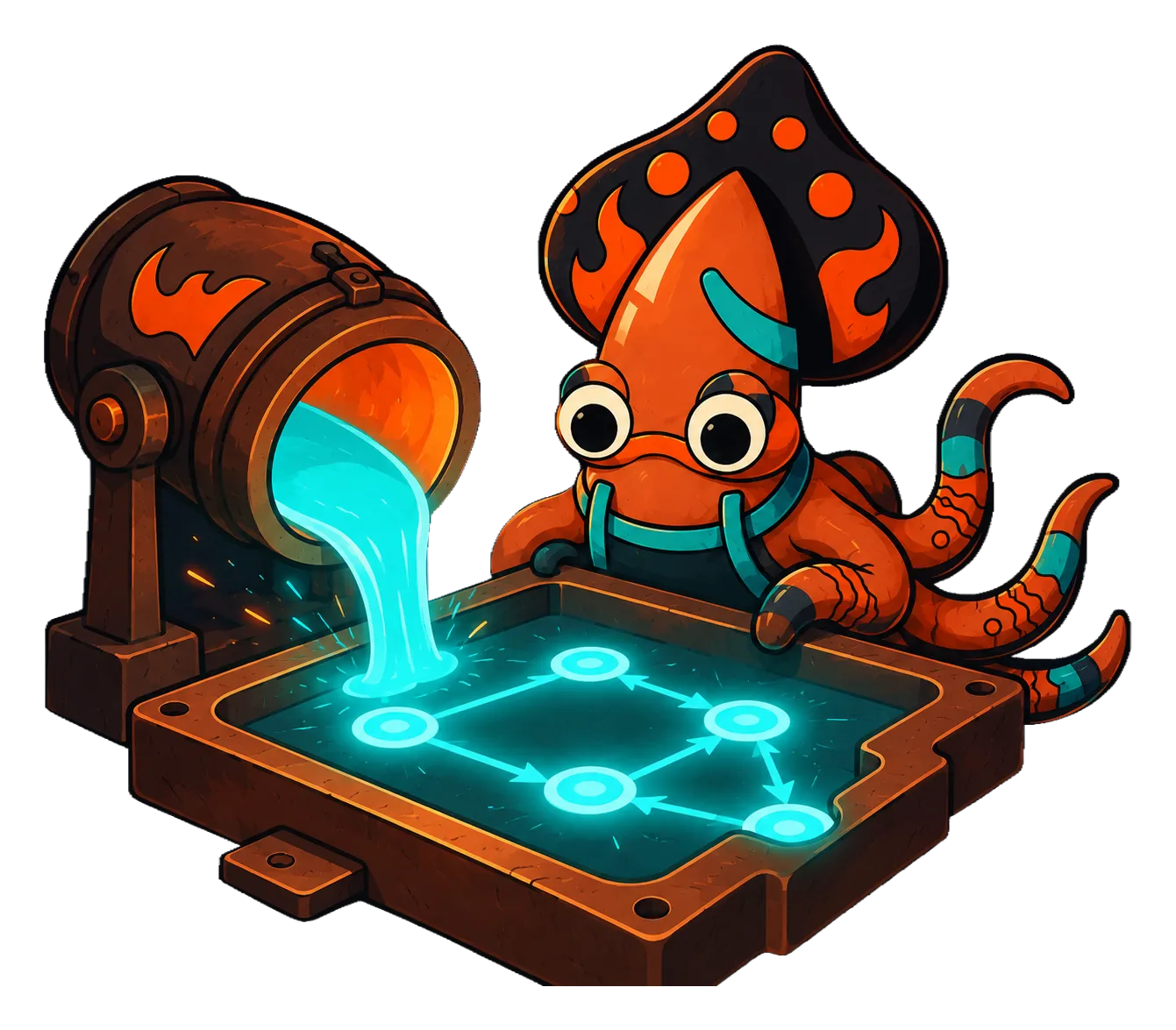
crucible/state is a statechart kernel for Go: an abstract, domain-agnostic
engine for modeling anything that moves through states in response to events:
an order, a payment, a device, a workflow. It is stdlib-only, generic over your
own state, event, and context types, and built so that advancing a machine is a
pure function.
What makes it different
Section titled “What makes it different”Most statechart libraries braid the definition of a machine together with the
implementation of its behavior and the IO it performs. crucible/state
separates all three:
- The machine is data. Its canonical form is a serializable IR: states, transitions, and behavior referenced by name and params. Nothing executable is embedded in the definition.
- Behavior is bound by name. A registry maps names to your Go functions (guards, actions, assign reducers, services). The same definition can be authored in Go today and in a visual editor later; both emit the same IR.
- Advancing is pure.
Firecomputes the next state and returns the effects to perform as data. It does no IO itself. The caller decides what to publish, store, or call.
Purity is not an aesthetic. It is what makes a machine verifiable and
durable-ready. Because state advances deterministically from (context, event), you can snapshot it, replay it, statically analyze reachable paths, and
verify that an externally-built entity is legally in a given state.
The shape of the API
Section titled “The shape of the API”The lifecycle reads as foundry verbs: Forge a builder, optionally Temper
it for diagnostics, Quench it into an immutable *Machine, Cast an
instance around your entity, then Fire events at it.
m := state.Forge[Status, Event, Order]("order").    Initial(Placed).    Transition(Placed).On(Pay).GoTo(Paid).    Quench()
inst := m.Cast(Order{ID: "A-1"})res := inst.Fire(context.Background(), Pay) // res.NewState == Paid; res.Effects is data
Next: Getting started.