
Serialization & visualization
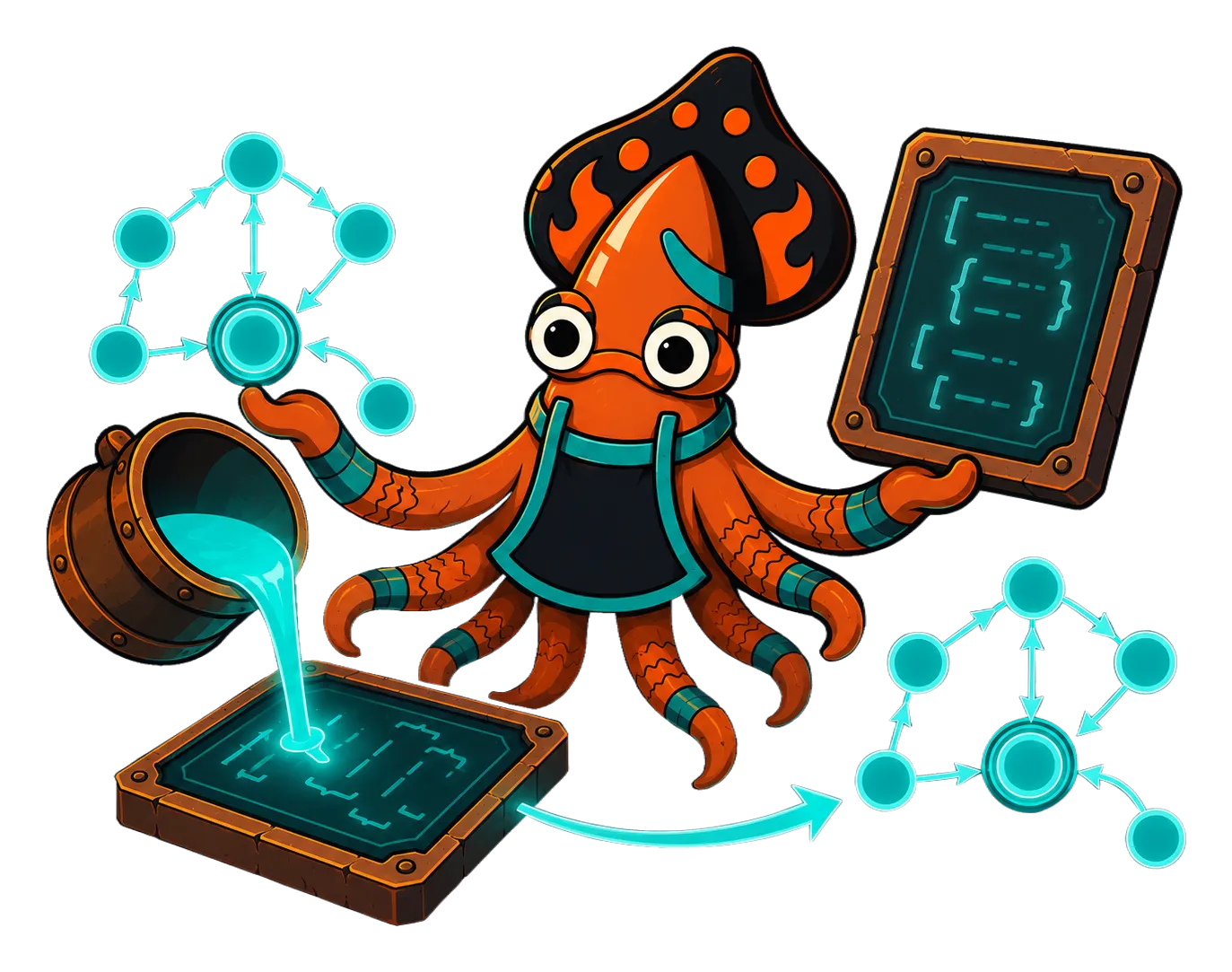
A Crucible machine has two faces. One is the running instance: guards firing, reducers folding context, actors and services doing work. The other is the machine’s definition: the states, the transitions, the hierarchy, the named hooks. That definition is the IR, and it is a first-class citizen: pure, lossless data you can write to disk, ship over a wire, diff in a pull request, or hand to a tool that never runs a single transition.
The split is deliberate. Structure is data; behavior is a named reference. A transition’s shape (its event, its target, its guard expression) lives in the IR. The guard’s implementation does not; the IR carries only its name. A host registry binds those names back to Go functions when the machine is re-quenched. So the IR round-trips through JSON without ever trying to serialize a closure, and two machines, one forged in code and one loaded from JSON, are the same machine.
This split unlocks the workflow Crucible is built around:
- Persist a definition and pin a durable instance to the exact version it derives from.
- Interchange machines between services, generators, and a future authoring UI, all reading and writing one canonical document.
- Tool over the structure (render diagrams, analyze reachability, verify invariants) without instantiating anything.
The next two pages cover the concrete surface: JSON IR for the round-trip, and visualization for the diagrams forged from the same graph. For the conceptual backbone, see the IR and the split.