
The Manifold and Outlet model
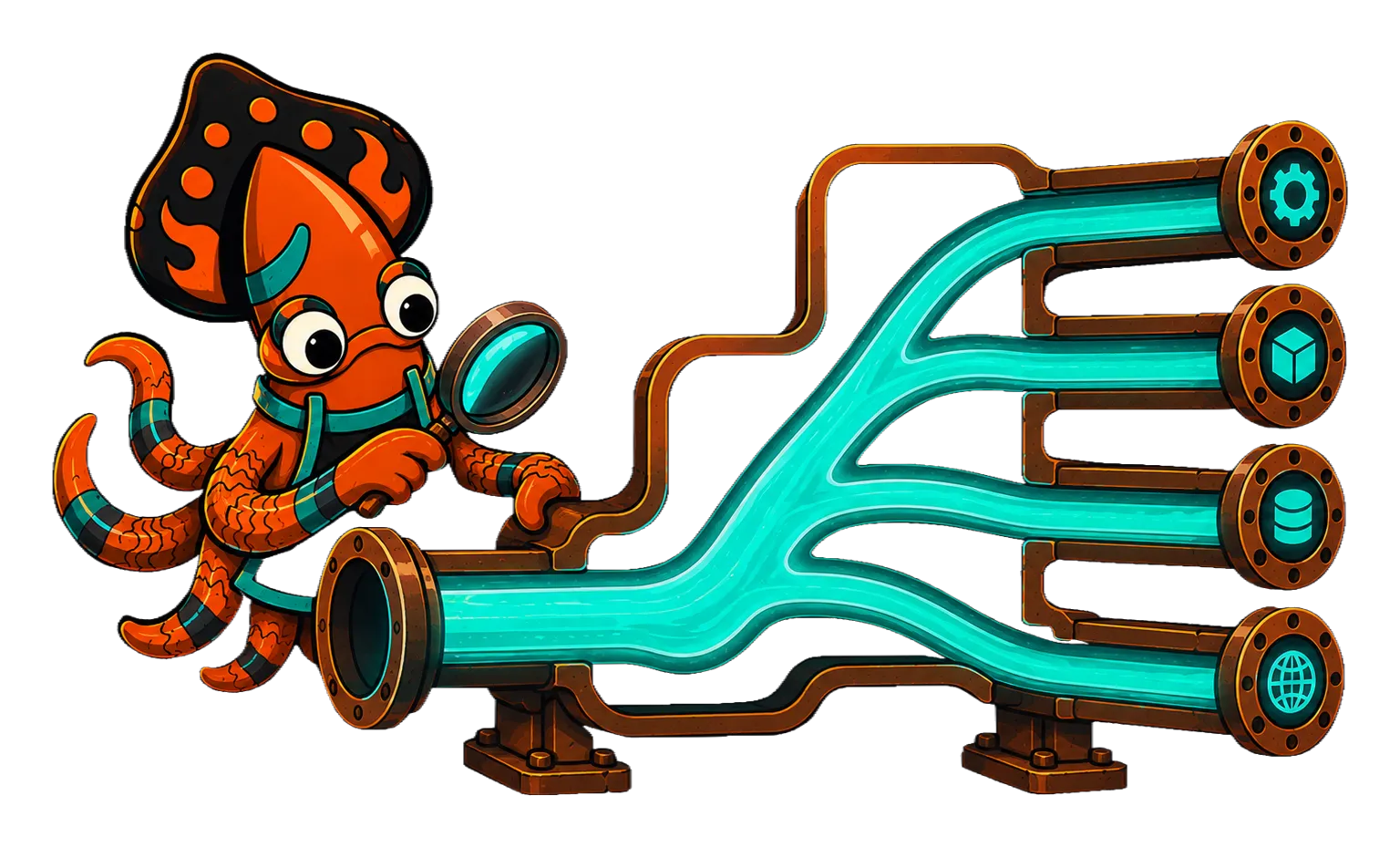
Two types carry the whole model.
Outlet: a single destination
Section titled “Outlet: a single destination”An Outlet is one place a payload can go:
type Outlet interface { Sink(ctx context.Context, payload any) error}Sink returns ErrUnregistered when the outlet has no handler for that
payload’s concrete type, a normal silent skip, not a failure. Any other error
is a real failure. The smallest possible outlet is a function:
m.Attach(sink.OutletFunc(func(ctx context.Context, p any) error { return publish(ctx, p)}))An outlet may also implement optional capabilities, which the Manifold detects by interface assertion and drives automatically. You never wire them by hand:
| Capability | Method | Driven by |
|---|---|---|
Flusher | Flush(ctx) error | Manifold.Flush |
BatchOutlet | SinkBatch(ctx, []any) error | Reservoir flushes |
Shutdowner | Shutdown(ctx) error | Manifold.Shutdown |
Manifold: one inlet, many outlets
Section titled “Manifold: one inlet, many outlets”A Manifold is the fan-out. Construct it with functional options, attach
outlets fluently, and emit:
m := sink.NewManifold(    sink.WithLogger(log),     // *slog.Logger; default discards    sink.WithTracer(tracer),  // telemetry.Tracer; default no-op    sink.WithMeter(meter),    // telemetry.Meter; default no-op)m.Attach(    sqlOutlet,    sink.Reservoir(s3Outlet, sink.WithBatchSize(100)),)
m.Sink(ctx, OrderPlaced{ID: "A-1"}) // fan out to every outlet
Every seam has a no-op default, so a zero-option NewManifold() is fully
functional and completely silent: it logs to a discard handler and records to
no-op telemetry. You opt into observability by passing real seams, never by
satisfying a required dependency.
flowchart TD
    subgraph Manifold
      direction LR
      S[Sink ctx, payload] --> F((fan-out))
    end
    F --> O1[Outlet: Emitter sql]
    F --> O2[Outlet: Reservoir → s3]
    F --> O3[Outlet: OutletFunc webhook]
    F -.skip.-> SK[/ErrUnregistered → counted, not logged/]
    F -.fail.-> ER[/error → logger + sink.failed/]
A Manifold is intentionally not itself an Outlet: its Sink is
fire-and-forget and returns nothing, while Outlet.Sink returns an error. To
nest one manifold inside another, bridge the two with an OutletFunc:
parent.Attach(sink.OutletFunc(func(ctx context.Context, p any) error { child.Sink(ctx, p) return nil}))Most destinations are not hand-written outlets, though. They are
Emitters built from a typed client and a registry.
The next page covers what happens to a payload once it enters the Manifold.