What is crucible/sink
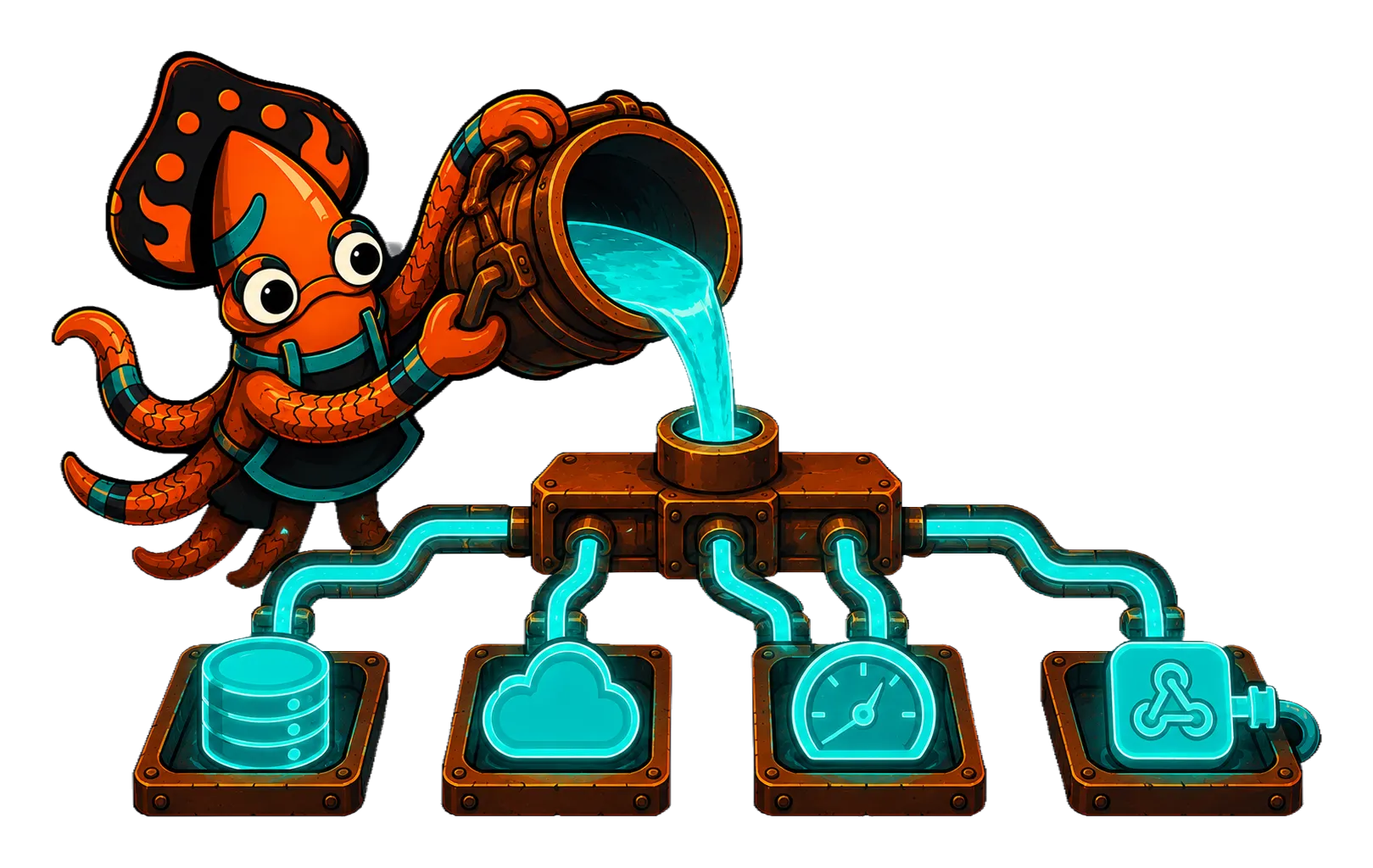
crucible/sink is the suite’s egress seam: a fire-and-forget fan-out emitter.
A service calls one method:
m.Sink(ctx, payload)The payload fans out to every attached destination: a SQL table, a DynamoDB item, a StatsD counter, a webhook, a log line. The call site never names which destinations are wired; that wiring lives in one place, set up once, and the emit path stays a single line forever.
Like every Crucible module, sink is built from thin seams with no-op defaults
and no forced dependencies. The core imports only the standard library and
crucible/telemetry; every vendor SDK lives in its
own optional sub-module, so you pull in exactly the destinations you use and
nothing else.
The shape of it
Section titled “The shape of it”A Manifold holds a set of Outlets
and dispatches each payload to all of them. Manifold.Sink is the only emit
path and it returns nothing. Failures go to the configured logger and metrics,
not back up the call stack.
flowchart LR
    P([payload]) --> M{{Manifold}}
    M --> A[sql]
    M --> B[dynamo]
    M --> C[statsd]
    M --> D[webhook]
    M -.errors.-> L[/slog logger + metrics/]
That is the whole idea: one inlet, many outlets, fire and forget. A caller
who genuinely needs confirmation for one critical destination holds that
Outlet directly and calls it for an honest per-destination error, but the
fan-out itself never blocks or surprises the call site.
Where it fits in the suite
Section titled “Where it fits in the suite”The state kernel decides what should happen
and emits effects as pure data; it
performs no IO. sink is a natural place to send those effects: the host’s
dispatch loop hands each effect to a Manifold, and the fan-out carries it to
the outside world. Neither module imports the other. They compose through the
optional bridge when you want them together, and
stand completely alone when you do not.
sink is the first of a small family of bring-your-own-adapter IO seams
(broker, source, and friends are on the roadmap), each defaulting to a no-op
and forcing nothing third-party on the consumer.
- The Manifold and Outlet model: the vocabulary.
- Fire-and-forget fan-out: semantics, errors, batching.
- Destinations: the sub-module catalog.
- Telemetry wiring and graceful shutdown.
- Fanning state transitions out: the optional
statebridge.