
Evolution
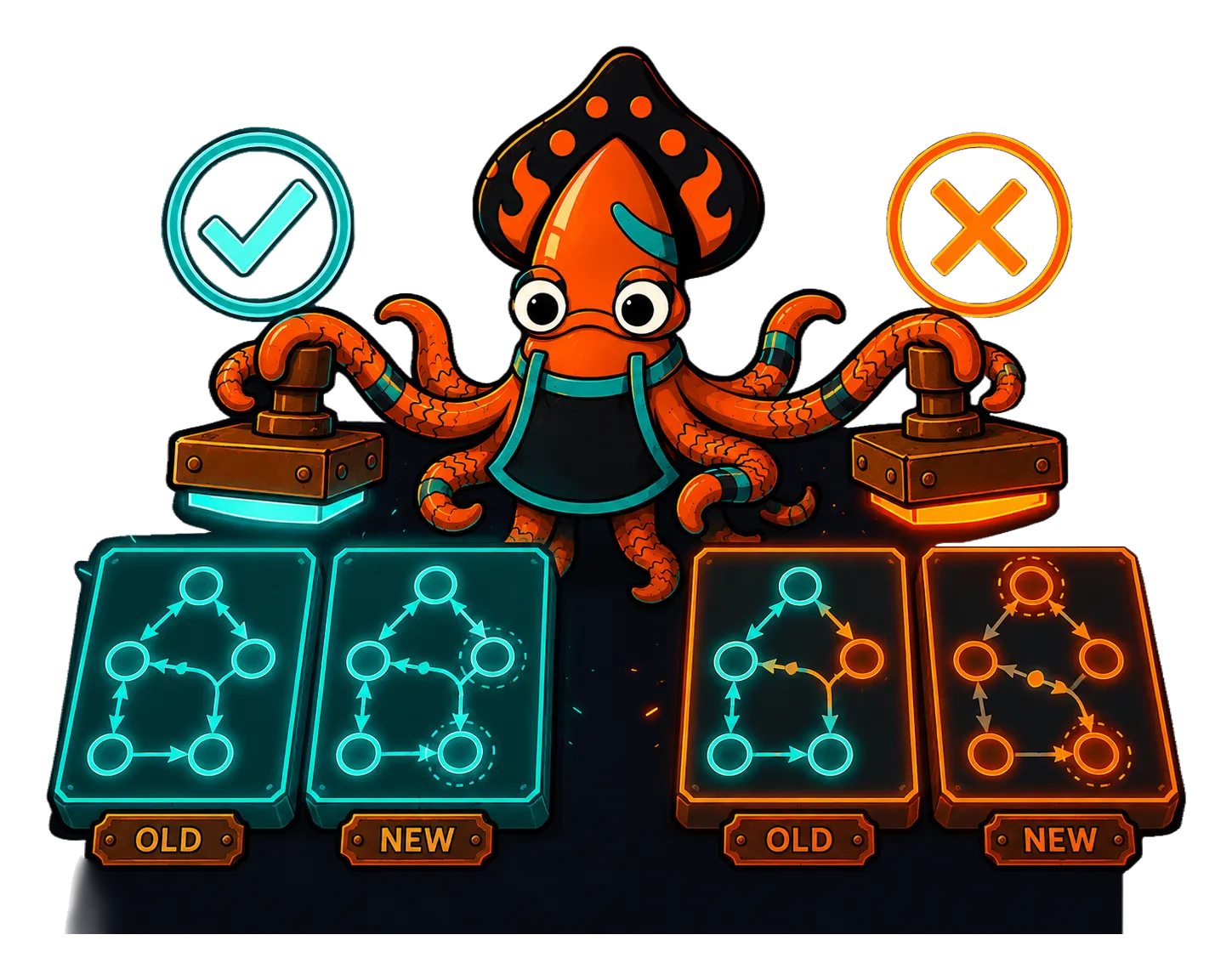
A machine definition is a contract. When you change it, you need to know whether the change is safe to roll out under the old version or whether it breaks existing instances. state/evolution answers that mechanically. It diffs two definitions, classifies each delta, and recommends a SemVer bump.
report := evolution.Diff(old, updated)fmt.Printf("breaking=%v bump=%s\n", report.Breaking(), report.SemverBump())// breaking=false bump=minorDiff works on the IR; DiffMachines takes two frozen *Machines, and DiffJSON takes two JSON definitions. The classification is the same whichever form you hold.
Each Change lands in a fixed bucket:
- Additive (backward-compatible,
minor): a new state, a new transition, a guard added or removed, an effect added or removed, metadata or wait-mode changes. - Breaking (
major): a removed state or transition, a retargeted transition, a changed initial or final state, a renamed machine. - Unknown → always treated as breaking and flagged for human review. The differ never silently waves through a delta it has no rule for.
SemverBump() rolls the whole report up to Patch, Minor, or Major, ready to drop straight into a release gate.
flowchart LR
    A[old definition] --> D{Diff}
    B[updated definition] --> D
    D -->|additive only| Minor[minor bump]
    D -->|any breaking| Major[major bump + migration]
    D -->|unknown delta| Flag[flagged: review]
Evolution pairs with live migration. When a diff is breaking, the bump is your signal to run the deprecation lifecycle rather than swapping the definition under running state: stand up the new definition alongside the old, migrate in-flight instances, then retire the old one.