
Delayed Transitions
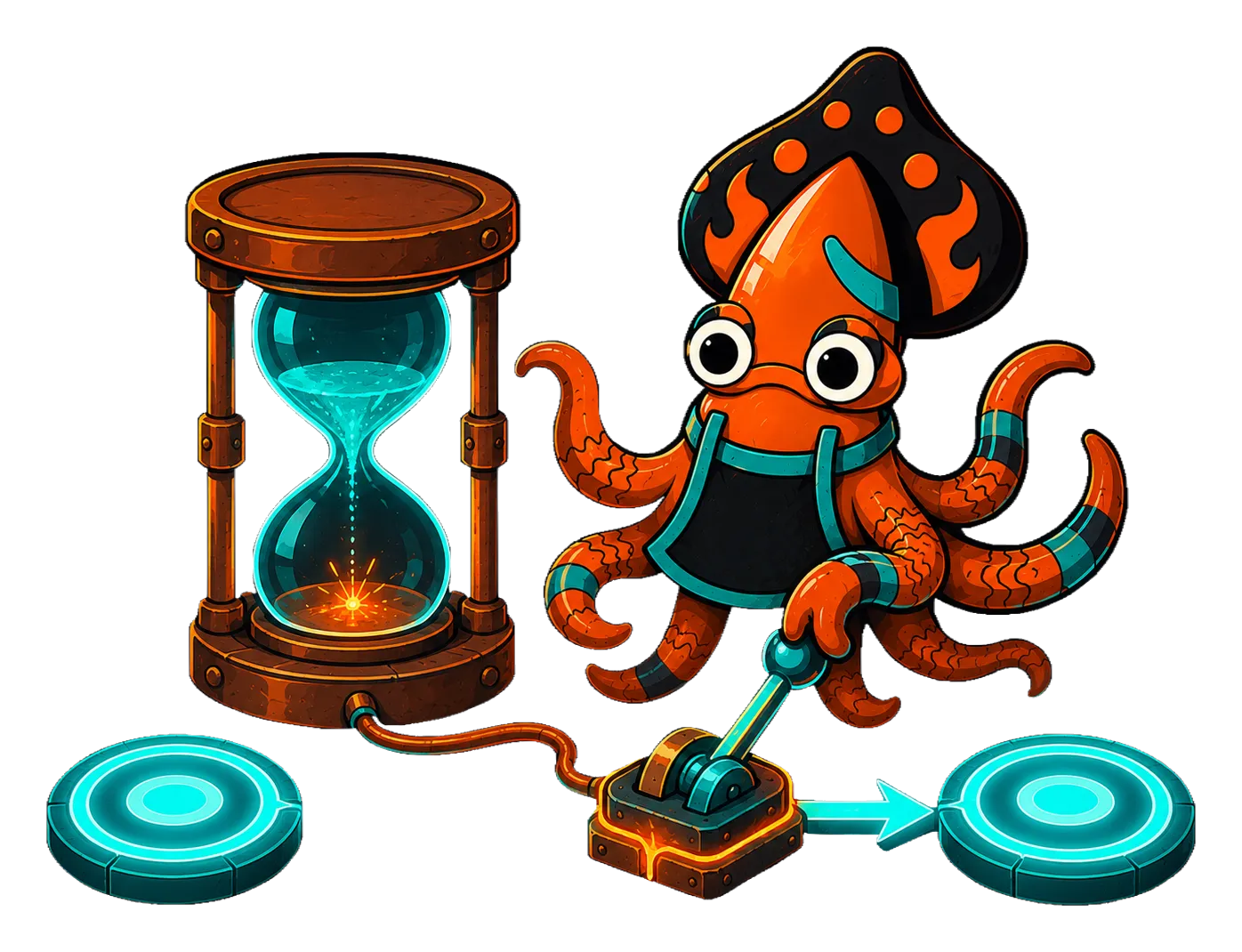
A delayed transition fires after a state has been active for a fixed duration: an SLA clock, a retry backoff, a session timeout. You declare it with After(d): on entering the source state the kernel emits a ScheduleAfter effect; if the state exits before the delay elapses, the kernel emits a cancel effect (auto-cancel-on-exit).
The kernel never sleeps. The host owns the timer, driven by a Scheduler over an injected clock seam, so time is fully deterministic in tests and real in production.
// In the Watchdog region: 30 minutes after OnTime is entered,// the SLABreached edge fires and lands in Overdue.b.Region("Watchdog"). SubState(OnTime). After(30 * time.Minute).On(SLABreached).GoTo(Overdue).Assign("markBreached"). SubState(Overdue).Final(). EndRegion()Wire a FakeClock and a Scheduler, then advance the clock to fire the edge deterministically:
clk := state.NewFakeClock(time.Unix(0, 0).UTC())sch := state.NewScheduler(inst)
clk.Advance(30 * time.Minute) // push past the SLA windowfor _, fr := range sch.Tick(ctx) {    absorb(ctx, fr.Effects) // SLABreached fired; effects flow back through Fire}
In production you swap the FakeClock for the system clock: the same After declaration, the same Scheduler.Tick, no time.Sleep anywhere in the kernel.
stateDiagram-v2
    state Watchdog {
        [*] --> OnTime
        OnTime --> Overdue: after(30m) / SLABreached
        Overdue --> [*]
    }
    note right of OnTime
        timer armed on entry,
        auto-cancelled on exit
    end note
Because the host re-feeds the delayed event through Fire, a delayed transition is just an ordinary transition with a clock-driven trigger. Guards, reducers, and parallel regions all behave exactly as they do for any event.